
TL;DR
- I launched RabbitHole on LinkedIn with a €35 promotion. It reached 12,091 impressions, a few people tried it, and nobody bought a single carrot (the app's credits).
- The engineering was not the problem. The product decisions were: a vague target user, a two-year MVP, no funnel tracking and validation that only came from friends.
- Next time: one user, one problem, one hypothesis, and measure everything from the first day.
On launch day I had a Stripe account, three pricing tiers, a trailer, and a rabbit with headphones.
A few weeks later I had twelve thousand impressions and zero euros.
If you haven't read it yet, Building RabbitHole tells how the product came to be. This one is about what happened once it met the real world, and about the mistakes I can only see now that it's over. I'm writing it down because post-mortems are useful exactly in proportion to how honest they are, and because I'd rather make each of these mistakes only once.
The launch
I announced RabbitHole in a LinkedIn post: the problem (learning in an endless chat window is a mess), the solution (structured guides with analogies, flashcards, quizzes and podcasts), the link, and the one-minute trailer. Then I paid €35 to promote it to an English-speaking audience in Spain.
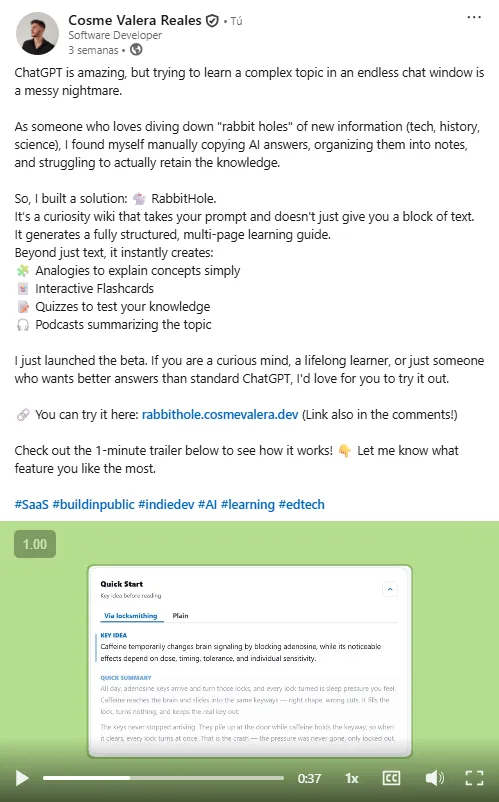
Here is the result:
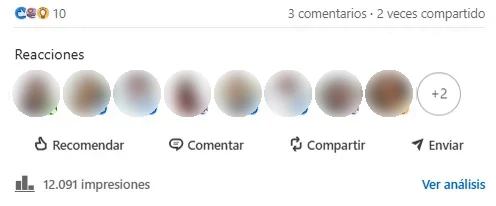
Twelve thousand people saw the post. Some of them opened the app. How many? I don't know, and that turned out to be one of the four mistakes. Nobody bought carrots.
What went well
Let me start with the good part, because there is one, and it's not small.
I built a complete SaaS on my own. Accounts, a database, three AI modes, billing, podcasts, a landing page, a public demo and a test suite. Two years ago I had a React dashboard with sonar buttons. Along the way I learned more about AI integration, UI/UX and payments than any course would have taught me, because every lesson came attached to a bug I had to fix myself.
And the project is on my CV now, which is not a bad ending for a product that never sold.
What went wrong
It didn't work as a product. Which, to be fair, is what happens to most first products. The interesting question is not whether it failed but why, and after a few weeks of thinking about it I keep coming back to the same four reasons.
1. "Curious people" is not a target user
RabbitHole was for curious people. That sounds like a target, but it's a mood. Everyone is curious about something, which means nobody in particular wakes up needing RabbitHole.
The product sat somewhere between ChatGPT, which is for everyone, and NotebookLM, which is for students working with their own material. And for a normal person it was hard to picture the exact moment when they'd open RabbitHole instead of just asking ChatGPT. If I can't describe that moment in one sentence, a stranger scrolling LinkedIn definitely won't figure it out for me.
The irony is that StudyMesh, the version before, had a clearer target: a student a week before an exam. That's a person, with a deadline and a problem. When I broadened the audience to make the idea bigger, I also made it harder to want.
2. An MVP that took two years
An MVP is supposed to answer one question as cheaply as possible: does anyone need this? Mine answered a different question for two years: what else can I build?
I never wrote down a hypothesis. Each version came from the previous one, through experimentation and whatever idea excited me that month: AI widgets, then study paths, then pets, then podcasts. For long stretches I had no clear next thing to test, so I built the next feature instead. That's how development turns into open-ended experimentation rather than validated iteration.
Everything in RabbitHole that matters (a guide, explained through what you already know) could have been tested in a couple of months. The carrots could have waited.
3. No funnel, no answers
This one hurts the most, because it was so easy to avoid.
I didn't track the funnel: landing page visit → sign-up → first guide created. Without it, 12,091 impressions is a number with nothing behind it. Did people see the post and not click? Click, look at the landing page and leave? Sign up and never create a guide? Create one and never come back? Each of those has a completely different fix, and I have no idea which one happened.
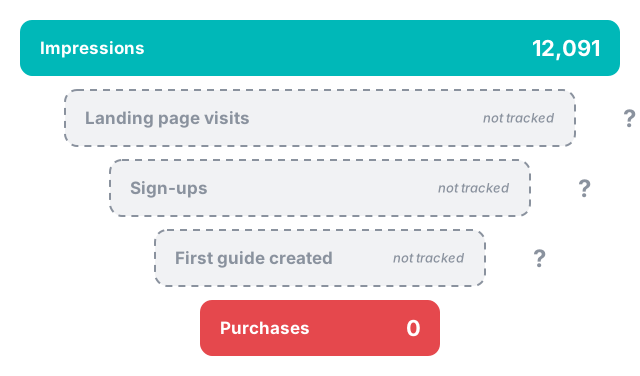
Twelve thousand impressions, and the only thing I learned from them is that I should have measured them.
4. Validation by WhatsApp group
My feedback came from a WhatsApp group: my three siblings, all developers, and six or seven friends. They are smart, honest and generous with their time. They were also not the target user, and people who love you are not the right people to tell you your product is unnecessary.
Looking back, the most valuable feedback I ever got was the first one, about AquaMesh (the first version of all this): nice idea, but not very practical. I answered it by renaming the product and adding AI. What I should have done is sit down with real students, ask how they actually study, and build the smallest thing that helped with that.
What I'd do differently
- Pick one specific user. Not "curious people", but someone with a name, a moment and a problem.
- Build the MVP in weeks, not years, and make it validate a single core problem.
- Write the hypothesis before the code. If there is no clear next hypothesis, the next feature is probably a guess.
- Instrument the funnel from day one: landing visits, sign-ups and the first real action.
- Validate with people who match the target user, not only with friends and family.
- Care about the "why" as much as the "how". Why would someone use this instead of what they already use?
That last point is the one I'm working on now. Engineering taught me how to build things; it never forced me to ask why anyone would want them. That's why I read Escaping the Build Trap by Melissa Perri. The "build trap" is what happens when a team measures success by the features it ships instead of the value it delivers, and reading it after RabbitHole has been slightly uncomfortable, in a good way. I was a one-person team, stuck in the trap.

RabbitHole didn't find its users. It did find me a better way to work: I'm a better engineer for having built it, and a better product thinker for having watched it not sell.
The app is still online, and the rabbit still answers questions. If you're curious, try a guide, no account needed.
And next time, the first thing I build won't be the product. It will be the question.