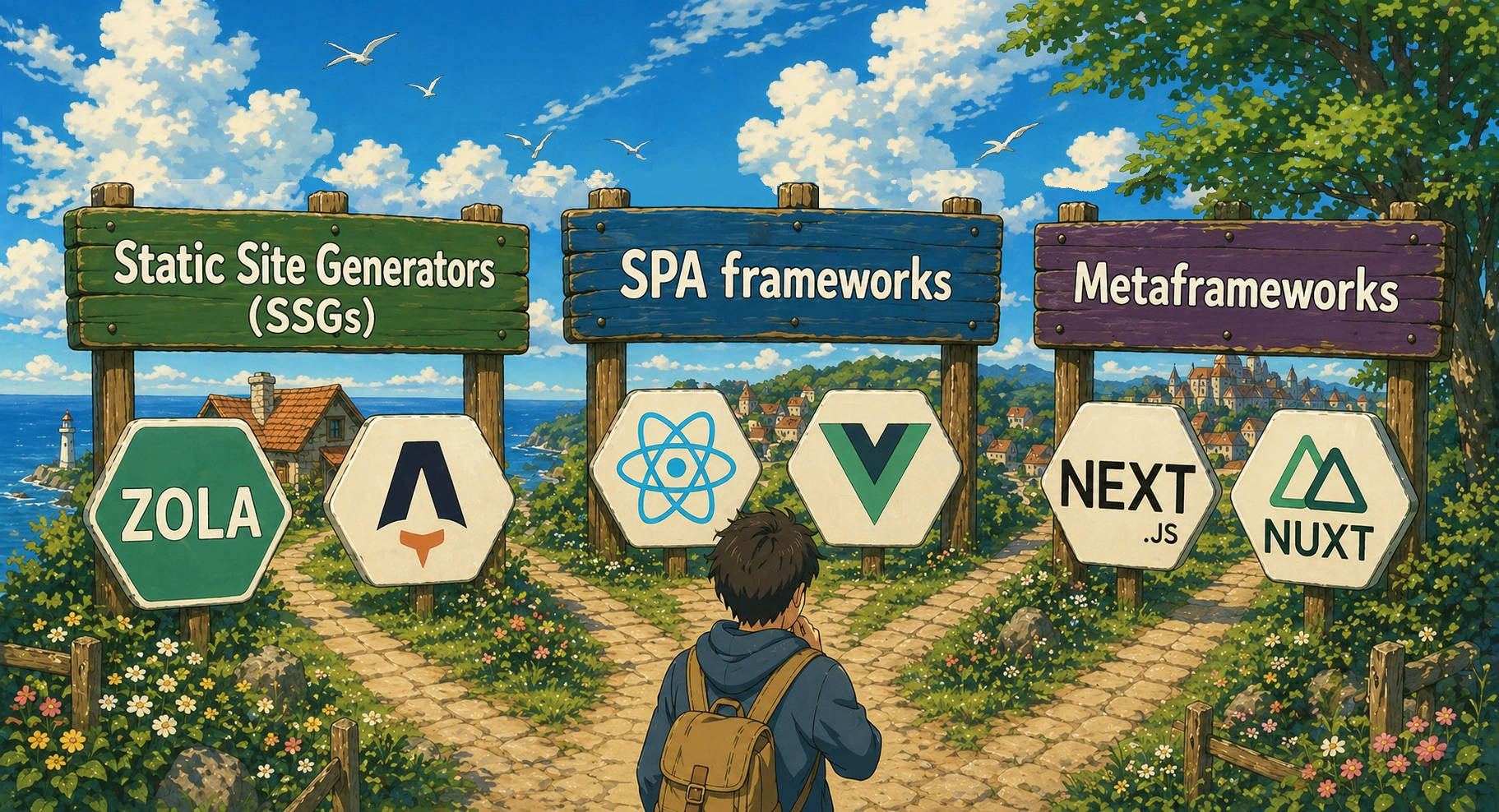
TL;DR
- SPAs / interactive apps built with React, Vue and Angular are best for stateful interfaces.
- SSGs like Zola and Astro are best for content-heavy sites: blogs, portfolios and landing pages.
- Meta-frameworks like Next.js and Nuxt are best when you need both interactivity and content pages in the same project.
- Documentation SSGs like VitePress and Docusaurus are SSGs specialized for documentation.
- The wrong tool can still work, but it usually costs you performance, simplicity, or developer experience.
Someone spent three weeks building a content pipeline in React: Markdown parsing, frontmatter, route generation, RSS..., before realising Astro ships all of that for free. The code worked. It just didn't need to exist.
The question isn't which framework is best?
The real question is: what kind of website am I building?
The practical buckets
There are three big families: SSGs, SPAs, and meta-frameworks. Documentation tools get their own note because their defaults differ from a normal blog or portfolio.
1. Static Site Generators (SSGs): Astro, Zola, Hugo, Jekyll
They take content (usually Markdown) + templates and using a build command they generate plain HTML/CSS/JS (the built pages are stored in a dist/public folder). In production, the page already exists as a file; the browser just downloads it. Great for content-heavy sites.
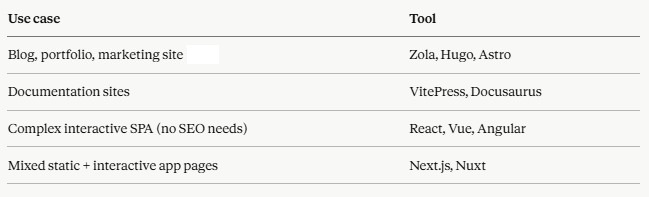
Tools like VitePress, Docusaurus and Nextra are SSGs too, but their defaults assume you're documenting a library (sidebars, search, code-focused navigation). For a blog or portfolio, pick Astro or Zola instead.
2. SPAs / interactive apps: React, Vue, Angular, Svelte
React, Vue, Angular and Svelte are commonly used to build SPAs: interactive apps where JavaScript handles routing, state, and UI updates in the browser. Best for stateful UIs behind a login, where SEO usually matters less. Angular in particular is mostly used for enterprise app-first projects; it has SSR support but no widely-adopted meta-framework equivalent to Next or Nuxt.
3. Meta-frameworks: Next.js, Nuxt, SvelteKit
They sit on top of React/Vue/Svelte and add routing, SSG, SSR, data loading, and deployment conventions. Use them when static content pages and app-like pages need to live in the same codebase: e-commerce (static product pages, interactive cart), SaaS (static marketing, full SPA dashboard), or a blog platform (generated posts, interactive editor). If your needs are cleanly one side or the other, a meta-framework is overkill.
The cost of picking the wrong tool
You can use any of these for any use case, but you pay a price when the tool doesn't match the problem.
Using React for a blog:
- You build your own content pipeline from scratch (Markdown parsing, frontmatter, route generation, syntax highlighting, RSS...). SSGs give you all of this for free.
- You usually ship much more JavaScript than a content site actually needs.
- SEO and initial load can suffer if content depends too much on client-side rendering.
Using Zola for an interactive app:
- No built-in component model, declarative rendering, or reactivity system.
- State management with plain JS gets messy fast once you have more than a couple of interacting pieces.
- You start reinventing what React/Vue already solve well.
Using Next.js when Astro or Zola is enough:
- You add more concepts, dependencies, and deployment concerns than the project needs.
- You may spend time managing rendering modes and framework conventions instead of shipping the site.
Astro: the modern SSG
If you're starting a content site today and want modern frontend features, Astro would probably be my default:
- Write React/Vue/Svelte components, Astro compiles them to plain HTML at build time.
- Islands architecture: only components you mark as interactive ship JS to the browser.
- Great MDX support (Markdown with embedded components).
- Large ecosystem of integrations and themes.
If you want something simpler, Zola is excellent: no Node.js, no npm, just a single Rust binary.

There's no single best web framework, only the right tool for what you're building.
If the project is mostly content, start with an SSG. If it is mostly state and interaction, start with an SPA framework. If it needs both, reach for a meta-framework.
Before starting a new project, ask: is this a content site, an interactive app, or both?
Those answers pick the category. The category picks the tool.